
Why LSF Titanium?
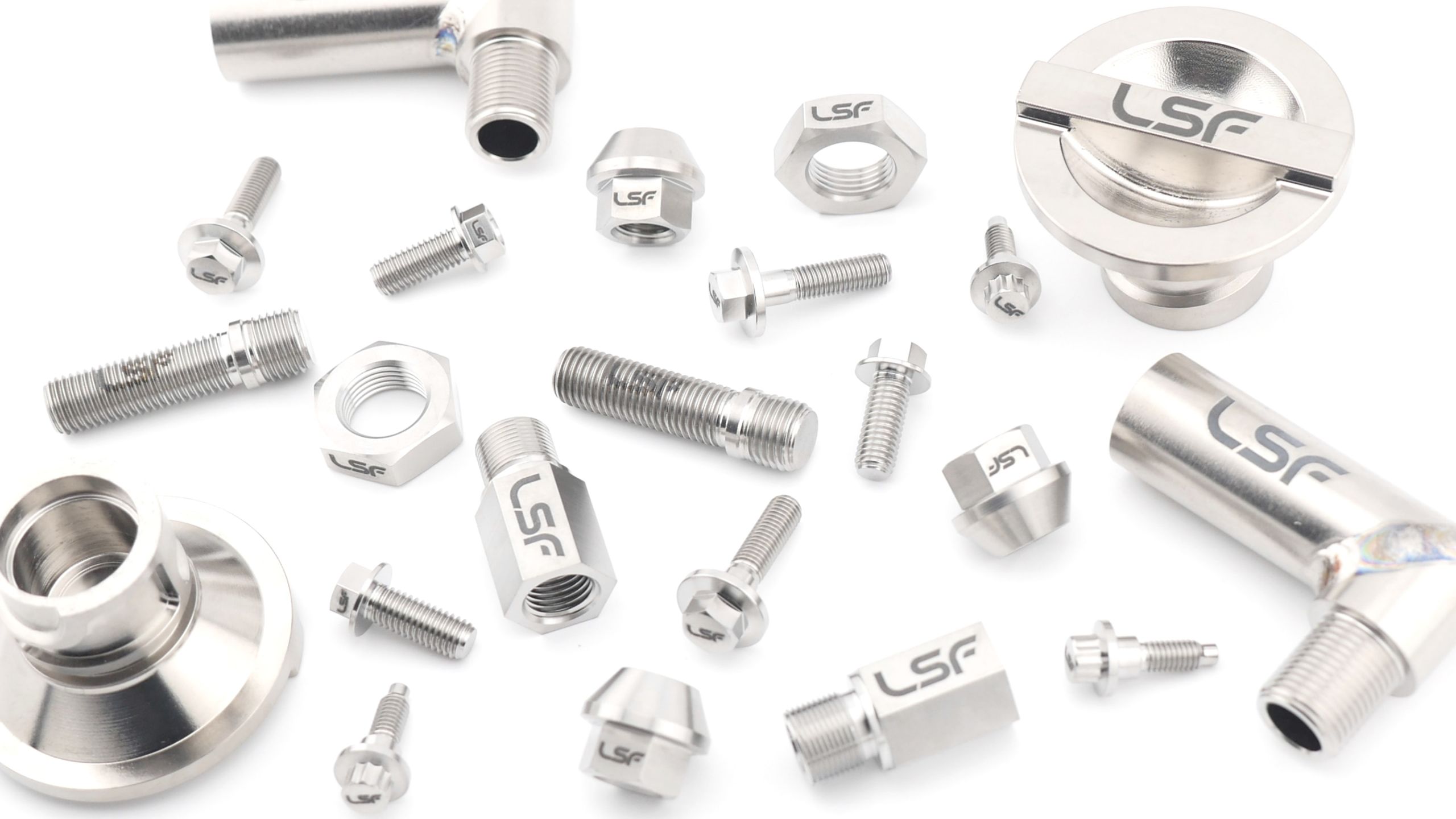
Why Choose Titanium?
Titanium has earned its reputation as one of the world’s premier engineering materials—not because it is exotic, but because it delivers an exceptional balance of mechanical performance, low weight, corrosion resistance, and long-term durability that few metals can match.
That’s why titanium is found in all forms of racing, aerospace, military aircraft, high-performance motorcycles, professional marine applications, medical implants, and spacecraft. These industries don’t choose titanium because it’s different—they choose it because it solves engineering problems.
Performance Through Weight Reduction
One of titanium’s greatest advantages is its outstanding strength-to-weight ratio.
For most applications, LSF Titanium utilizes Grade 5 Titanium (Ti-6Al-4V), the alloy used in many high-performance fasteners and engineered components. This material has a density of approximately 4.43 g/cm³, compared to approximately 7.85 g/cm³ for carbon and alloy steels. In practical terms, titanium weighs about 43% less than steel.
For performance vehicles, reducing weight means more than improving acceleration. Every pound removed from a vehicle reduces the energy required to accelerate, decelerate, and change direction. Weight savings become even more valuable when they occur in rotating assemblies, unsprung components, or locations high on the vehicle where reducing mass lowers the center of gravity. The result is a vehicle that can respond more quickly, handle more precisely, and operate more efficiently.
Exceptional Strength
Lightweight does not mean weak.
Grade 5 titanium typically provides ultimate tensile strengths in the range of 900–1,100 MPa (130–160 ksi) depending on processing and heat treatment—comparable to many high-strength alloy steels while weighing substantially less.
The true engineering advantage is specific strength—the amount of strength provided for a given weight. Titanium offers one of the highest specific strengths of any structural engineering metal, allowing engineers to reduce mass without sacrificing structural integrity.
Outstanding Corrosion Resistance
Unlike steel, titanium forms an extremely thin, stable oxide layer on its surface almost instantly when exposed to oxygen. This passive oxide film continuously protects the underlying metal from corrosion and, if damaged, naturally reforms in most environments.
Unlike plated steel hardware, there is no coating to chip, peel, or wear away.
Titanium performs exceptionally well in environments involving:
For many applications, titanium can provide decades of service with little change in appearance or mechanical performance.
Fatigue Resistance
Many mechanical components fail not because they experience one excessive load, but because they experience millions of repeated loading cycles. This phenomenon—known as fatigue—is a primary design consideration in motorsports, aerospace, and industrial engineering. Titanium alloys exhibit excellent fatigue performance when properly designed and manufactured. Combined with precision machining and controlled manufacturing processes, titanium components can provide exceptional long-term reliability in cyclic loading environments.
High Temperature Performance
Performance vehicles create tremendous heat.
Turbochargers, exhaust systems, braking systems, engine compartments, and drivetrain components routinely experience elevated temperatures that can challenge conventional materials. Titanium retains useful mechanical properties at temperatures where many aluminum alloys begin losing significant strength while also resisting oxidation better than many steels in demanding environments. This makes titanium an excellent material for numerous performance applications where heat, weight, and durability intersect.
Precision Engineering Matters
Choosing titanium alone does not guarantee superior performance.
Material selection is only one part of good engineering.
The geometry of the component, thread design, manufacturing tolerances, surface finish, heat treatment, and quality control all influence how a part performs in service.
At LSF Titanium, we focus on the complete engineering solution—not simply the material. Every product is designed to optimize the unique characteristics of titanium while meeting the demanding requirements of high-performance automotive, motorsports, motorcycle, powersports, and marine applications.
Built for Those Who Demand More
Professional race teams, aerospace engineers, manufacturers, and serious enthusiasts understand that the smallest components often have the greatest impact on reliability.
Whether it’s reducing weight, resisting corrosion, improving durability, or delivering uncompromising precision, titanium continues to set the benchmark for demanding applications.
At LSF Titanium, we engineer products that allow our customers to take full advantage of everything this remarkable material has to offer.
Engineered Titanium Solutions – Lighter. Stronger. Faster.